

For many UK SMEs, standing still feels like the safest option.
When cashflow is under pressure, demand is uncertain and long-term decisions feel increasingly risky, delaying investment can seem like a sensible response. Stretch the life of existing equipment. Put upgrades on hold. Make do for another year.
But what if standing still is creating its own costs?
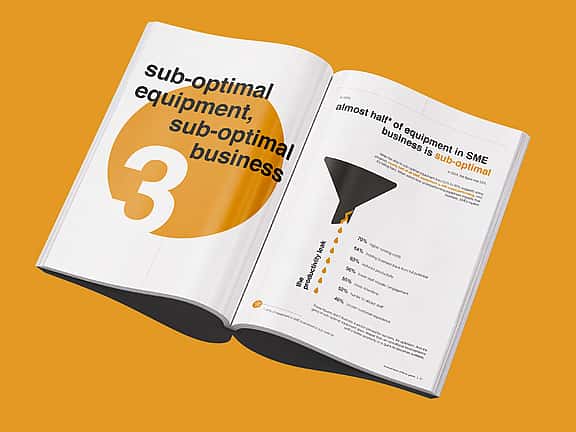
One of the most revealing findings from Renewed Lease of Life 2026 is that 46% of SME equipment is now considered sub-optimal. While that may sound like a simple operational issue, the implications are far more significant.
We call it The Productivity Leak.
And for many businesses, it's happening in plain sight.
When equipment becomes a hidden barrier
Most businesses can identify a major equipment failure.
- A machine that stops working.
- A server that crashes.
- A vehicle that breaks down.
The challenge with sub-optimal equipment is that the impact is often less visible.
- Technology still functions.
- Machinery still operates.
- Systems still deliver the minimum required.
- But performance slowly declines.
- Processes take longer.
- Maintenance costs increase.
- Productivity slips.
- Employees become frustrated.
The business adapts to inefficiency without necessarily recognising the cumulative cost.
Over time, what begins as a temporary compromise becomes the new normal.
The true cost of delay
Our research found that businesses using sub-optimal equipment reported:
-
Higher running costs
-
Reduced productivity
-
Increased downtime
-
Lower employee engagement
-
Greater difficulty reaching business goals
These findings challenge a common assumption among SMEs. Many businesses view delaying investment as a way of reducing financial risk.
In reality, postponing upgrades can simply transfer that cost elsewhere in the organisation. The expense may not appear as a capital outlay, but it emerges through lost productivity, operational inefficiencies and missed opportunities.
In that sense, standing still is rarely free.
The modernisation dilemma
What makes this challenge particularly difficult is that businesses understand the need to modernise.
Our research found that 57% of SMEs feel pressure to upgrade equipment, technology or systems.
The drivers are everywhere. Competitors are investing. Customer expectations are changing. Sustainability requirements are increasing. Artificial intelligence is accelerating the pace of technological change. Business leaders know they need to keep up.
The issue is confidence.
Many organisations are caught between two competing realities:
-
The need to modernise.
-
The need to protect cashflow.
The result is a growing state of what we might call modernisation paralysis.
The intention to move forward exists. The confidence to act does not.
Why productivity matters more than ever
For much of the last decade, growth has dominated business conversations. Today, resilience is taking centre stage. But resilience is not simply about cutting costs or preserving cash. It is also about ensuring businesses have the tools, systems and capabilities required to remain competitive.
In an environment where margins are under pressure and resources are stretched, productivity becomes one of the most important drivers of resilience. Businesses that can do more with less will always be better positioned to navigate uncertainty. That makes the Productivity Leak more than an operational issue.
It becomes a strategic one.
Looking beyond the purchase price
Perhaps the most important lesson from the Productivity Leak is that investment decisions should not be evaluated purely on their upfront cost. The real question is often:
What is the cost of not investing?
What opportunities are being delayed?
What efficiencies are being missed?
What impact is outdated equipment having on employees, customers and competitiveness?
As SMEs continue to navigate uncertainty, these questions will become increasingly important. Because while standing still may feel safer in the short term, the hidden cost of delay is becoming harder for businesses to ignore.
And in today's economy, resilience depends not only on surviving pressure, but on maintaining the ability to move forward.